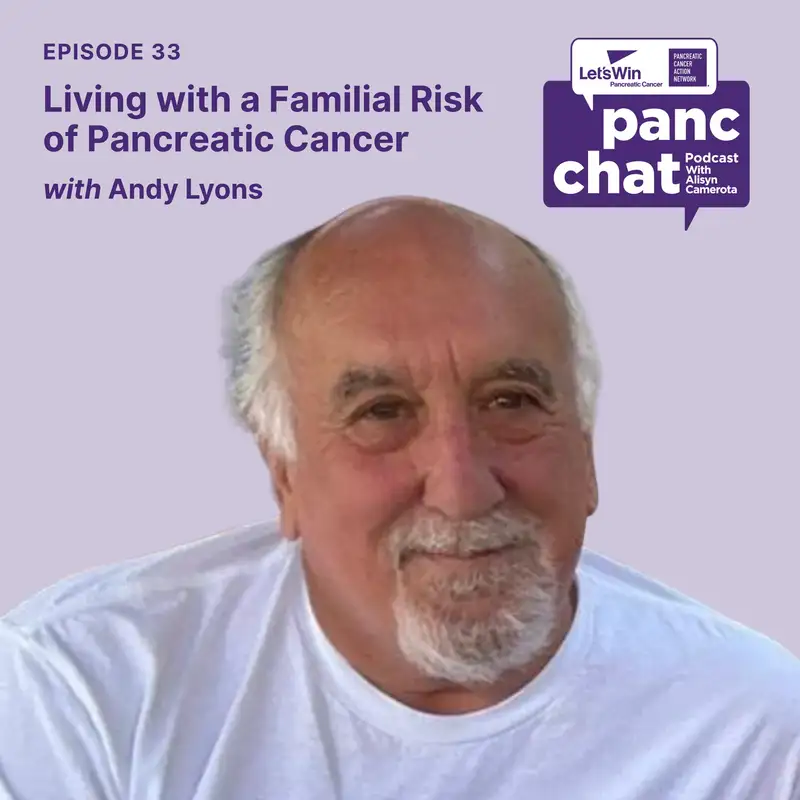
Living with a Familial Risk of Pancreatic Cancer
Cindy Gavin: Hi everyone, I'm Cindy Gavin, CEO and co-founder of Let's Win Pancreatic Cancer. November is Pancreatic Cancer Awareness Month. And today we are going to cover an important topic, living with high risk for pancreatic cancer, featuring long-term survivor Andy Lyons.
Over to you, Alisyn.
Alisyn Camerota: Hi, everyone. Welcome to PancChat. I'm your host, Alisyn Camerota. We want to welcome you, our listeners, to this episode and also to thank our sponsor, Revolution Medicines. Today's episode focuses on living with a high-risk predisposition to pancreatic cancer.
Our guest today is Andy Lyons. Andy is a patient advocate. Pancreatic cancer runs in his family and took the lives of many of his relatives. Andy will share the steps he took to monitor himself for pancreatic cancer, as well as the story behind his early diagnosis and how he continues to move forward even with his high risk. Andy, welcome to PancChat.
Andy Lyons: Hey, thank you. Thanks, Alisyn.
Alisyn Camerota: Thanks for being here. I've been looking forward to talking. So let's start at the beginning. Tell us about your family and the history with pancreatic cancer.
Andy Lyons: Okay, it's a long history. As far as I know, it started — and I'm sure it started before — with my grandmother. So my grandmother died from pancreatic cancer, as did two, maybe three of her sisters, and then my mother, and then her twin sister, and then their brother, and then finally my brother. And finally, it's when my brother was dying almost in my arms that we said, you know, obviously, there's something here.
We never put two and two together. We were workaholics, and we had no time to take care of ourselves. And this was, like, 27, almost 30 years ago. What did we know? Cancer was cancer.
We didn't know. We just didn't put the pieces together, but then when we finally did, I was determined not to let it happen to me. First of all, I wasn't ready to die. There's too much life yet to live.
But also, I feel that there's, you know, this gene in here that maybe could save some lives, and I wanted to find that and see if we could help other people.
Alisyn Camerota: How old was your brother when he died?
Andy Lyons: He was 56.
Alisyn Camerota: And so when you decided this isn't gonna be my story, and I have too much life left to live, what did you do? What was your first step?
Andy Lyons: I tracked down an oncologist in Des Moines. And, again, what did I know? I figured cancer's cancer, an oncologist's an oncologist. But also, pancreatic cancer then was kind of a new beast, in that it wasn't getting as much attention as all the other ones.
So I found a well-known oncologist and started seeing him, told him the story. So we started out. I'd go in. We'd have a little talk, and then I'd go have a scan, and then I'd come back in a couple of days, and we'd go over the scan. And in my third year — and again, no offense to the doc, but I was just naive. I didn't think about researching it. But in my third year, I walked in. Well…
Alisyn Camerota: Let me just interrupt you. So how many years ago was this?
Andy Lyons: This was probably '25, '26, '24.
Alisyn Camerota: Okay. 25 or 26 years ago, and you wanted to start being monitored, and was that a hard sell? I mean, when you said, I wanna start being scanned and monitored, was that very unorthodox? Did they fight you on that?
Andy Lyons: Oh, no. Not at all. Not at all. And if it was unorthodox, welcome to my life. Why be normal?
But no, he seemed pretty encouraged about it. But the third year I went in, my first meeting with him, he said, “Boy, your scan looks great, Andy.” I said, “Oh, I haven't had one yet.” And I realized I just wasted two years of my life, and tick, tick, tick.
But wait a minute.
Alisyn Camerota: What does that mean? What does that mean that he said your scan looks great? What was he looking—
Andy Lyons: He hadn't looked at it yet. I hadn't had one yet that year.
Alisyn Camerota: And so he was making it up, or he was looking—
Andy Lyons: I just don't think he was paying attention to the charts he was looking at. He was looking at the year before and not putting two and two together.
Alisyn Camerota: Okay. So what was your revelation after that?
Andy Lyons: I mean, I felt that I had wasted the time and we needed to get going on this. And so I went home and, of course, I got on the internet. I did a search for a pancreatic cancer specialist in the Midwest.
And the first one that popped up was in Omaha. It looked great. I called his office, talked to his nurse, and she said, “Can I ask why you're calling?” And I told her, and she said, “Well, you found the right person. Not only is he a specialist in pancreatic cancer, but he's conducting a familial pancreatic cancer research study, and I think you'd be a pretty good candidate for it, but that's not for me to say.”
Okay. So she said, “Let me get your information, and I'll pass it on to him. Oh, but there's bad news.” What? “He just moved to Chicago.”
Oh, that's no big deal. So what? It's not that far. And I called, like, a half hour later, and he picked up the phone. “Is this Andy? I've been waiting for your call.” Oh. And that just started… Well, I'm gonna go see him next week.
We've just become, you know, the best of friends and family. So I started seeing him, but I had to get accepted to a study. So I went to Chicago, Northwestern University, and met with him. He said, “You know, I have to ask you a few questions.” He came out with a book.
It was like this thick. Crap. We're gonna be here all day. And so the first question was, “Do you have any Eastern European Jewish heritage?” I said, “I do.”
He said, “Do you have a family history of pancreatic cancer?” “I do.” And he closed the book and said, “You're in the study.” So I stayed there for two days. We did ultrasound endoscopies, some blood tests, and that just started twenty-some years of doing it.
Somewhere in there, he moved to Pittsburgh. So he said, “I got some more bad news. I'm going to Pittsburgh.” Well, that wasn't bad news. And that's become, like, our vacation.
Alisyn Camerota: When you started this, and you were traveling to Chicago, you were living in Iowa at that time?
Andy Lyons: Yes. Absolutely. Yes.
Alisyn Camerota: And so how often were you traveling for surveillance to see—
Andy Lyons: For the first four years, I was there twice a year. And then when we went to Pittsburgh, then it was just once a year. But I also had scans in Des Moines twice a year and passed them on to him to look at, and ultimately to my surgeon to look at.
Alisyn Camerota: And when he asked you, “Are you of Eastern European extraction and Jewish descent?” — is there a connection between that and pancreatic cancer?
Andy Lyons: Yes, a very strong one.
Alisyn Camerota: I didn't know that. Okay, and so once you were in that study, what was the surveillance and the monitoring and the testing like?
Andy Lyons: Besides doing the CAT scans, I would do an ultrasound endoscopy, which was kind of like a colonoscopy, but going down the other way, check out the pancreas and take snips and snaps of all kinds of things, and some blood tests, lots of blood tests, you know, for research elsewhere. You know, actually, it was no big deal. The first couple of years, it was kind of frightening because I didn't know anything about it. After that, it was just like, let's do this.
And then with the study, at that point it was new. My doc said he was kind of operating in a vacuum. People weren't sharing the materials. I'm not sure why, but now my blood is going all around the world. It's pretty exciting.
Alisyn Camerota: And why is your blood going all around the world?
Andy Lyons: Because they wanna find the answer, because obviously there's something in here, in my body. I've had, you know, probably 10 genetic tests, and nothing has been discovered yet.
Alisyn Camerota: Okay. This is fascinating. So though it seems quite obvious based upon the circumstances that there is some sort of genetic predisposition in your family, they've never found a genetic link with you?
Andy Lyons: Not yet.
Alisyn Camerota: When you say genetic testing, is that just a blood test?
Andy Lyons: Mhmm.
Alisyn Camerota: And they look at the whole panoply of your genes and see if there's—
Andy Lyons: A mutation. I mean, when I first started, you know, they were maybe looking at five or six different genes. I think the last time it was 70 or so. So it's just getting better and better and better.
Alisyn Camerota: Yeah. It is getting more comprehensive. But are they looking — they take your blood, and then they're looking for a mutation? Is that how genetic testing works?
Andy Lyons: I'm assuming. Hey, I'm just the blood giver, the bloodletter. I don't know.
So, you know, I don't ask the questions. Pretty much when I started this whole episode of my life, I just handed him the car keys and said, “Here. You drive.” And I knew I was in great hands the first time I met him, so it just felt right.
Alisyn Camerota: Okay, so you've been doing genetic testing, and it's been getting more and more comprehensive, and you've been doing the endoscopies and the CAT scans. And so during this whole time, these twenty years, did you have a feeling of this is inevitable for me, or did you think you would dodge this outcome?
Andy Lyons: Oh, no. I knew it was inevitable. You know, people say, “Oh, you're so lucky.” Luck had nothing to do with it. It was perseverance and diligence, and I was vigilant about it.
It was, you know, a pretty sure bet that it was gonna happen. I just wanted to make sure it wasn't a bet I was gonna take, because that was a fool's bet. But, yeah, I just wanted to be prepared.
And, again, they just needed to find it.
Alisyn Camerota: And so then did they find something?
Andy Lyons: They did. I was diagnosed five years ago, two days ago. And it was the best — excuse me, best-case scenario. Right place at the right time.
You know, my doc was fabulous. University of Pittsburgh has a wonderful pancreatic cancer surgical oncologist, a couple of them. And so I was diagnosed on Wednesday. The doc said, “How long are you in town for?” I said, “As long as I need to be.”
We had planned to go to the Great Smokies after my ultrasound and endoscopy. We haven't been there yet. But I met with the surgeon two days later and had surgery two weeks later.
Alisyn Camerota: So that day of diagnosis, even though you had thought it was inevitable, even though you'd seen this horrible movie before throughout your family, was that a shocking day that you were actually diagnosed?
Andy Lyons: Well, yes. I never knew how deafening the silence could be. But when he told me the news, I was just like… And then the doc was great. He was in tears.
We were in tears. The nurses in the recovery room were in tears. I've been going there long enough. It was just like going to a family reunion. And so, after everything kinda calmed down, the doc — Doctor Lifesaver, I call him — came in and said, you know, this is what we've been waiting for.
We've been looking for this for all this time, and here it is. And that's a good thing because it's just starting. It's gonna make surgery easier. It's gonna make recovery easier, and it's a good thing. Yes, it's cancer, but it's a good thing.
Alisyn Camerota: Wow. So you got the diagnosis, and two weeks later you had the Whipple procedure. Is that the surgery?
Andy Lyons: Yes. But robotically. Because the tumor was so small, they could do it robotically. So there were just, like, four or five little poke holes and then an incision about, oh, about that big.
Alisyn Camerota: And was your recovery easier than other people's?
Andy Lyons: Yes. Supposedly. I mean, it was no piece of cake for me. Plus, I had to share a room with the world's loudest snorer. But, you know, so what? But, yeah, I was in the hospital for—
Alisyn Camerota: That seems cruel that you had to have a shared room after that. So, in other words, you caught it at stage one. Is that the terminology?
Andy Lyons: No. We never even talked about stages. I always like to call it a stage. It was just starting. And, really, I mean, that's what made it…
That was the beauty of it. And again, that's what we were looking for. So it was—
Alisyn Camerota: And so what has happened since that time five years ago?
Andy Lyons: Well, after I was in Pittsburgh — I was in the hospital for five days recovering and then hung out in town for, like, another week or so. We celebrated my wife's birthday, my birthday, and Thanksgiving at our doctor's house. And then I came back to Des Moines and, shortly after the first year, started 12 rounds of chemo. It was just one of those preventative things.
I like to call it cleanup in Aisle 9. You know, the doc was pretty sure he got it all, but just in case.
Alisyn Camerota: So you did 12 rounds of chemo. That was five years ago?
Andy Lyons: Yep.
Alisyn Camerota: And that was—
Andy Lyons: I've been out… Well, yes. It started then. Yes.
Alisyn Camerota: It started then? Okay. And then what happened after that?
Andy Lyons: Then I continued to have scans done to have them check things out. It was a year later, I went back to Pittsburgh, met with the surgeon. He looked at everything.
He said, “You know what? You're cancer free.” I said, “Could you say that again?” And he did. And I still have the annual checkups. I have ultrasound endoscopies, and then I meet with the surgeon every year. And he's looking at the scans, and I'll continue to do that until they find the gene.
Alisyn Camerota: So, you know, there's that phenomenon that people talk about, scanxiety.
Andy Lyons: Oh my gosh.
Alisyn Camerota: Yeah. How do you experience it? What's it like when you go in every year for you?
Andy Lyons: Like this year, when I had the scans, it wasn't so bad because I felt pretty good. But, you know, I don't wanna get complacent about it, and I don't wanna get arrogant about it, because that's when it's gonna happen. Matter of fact, when I got diagnosed, like I said, we were gonna go to the Great Smokies.
My wife said, “Yeah, you're not gonna get it. You have more of your dad than your mom.” I said, “Okay.” Damn it. I got it. Oh, sorry. And that's when I was diagnosed. And, yeah, I don't take it for granted. I think it's very important to stay on top of it.
And when I asked the doc, I said, “So, cancer free. Is cancer gonna come back?” He said, “Not that one, but you could get another one.”
Alisyn Camerota: Oh my gosh. That's not a good answer.
Andy Lyons: Well, but he said, “You're gonna keep checking every year?” I said, “Yep.” He said, “Then that's okay.”
Alisyn Camerota: So since that first 12 rounds of chemo, you haven't been on chemo since then?
Andy Lyons: No, thankfully.
Alisyn Camerota: That's great. That's great. And so, Andy, has this changed — getting that early diagnosis, having the surgery, I mean, always fearing that this was going to happen and then it happened? How has this changed your life and your outlook on life, really?
Andy Lyons: See, that's a tough question. You know, even though I knew it was going to happen, I wasn't petrified. I wasn't scared, you know, because I knew that we were taking the right steps. Again, I was a workaholic. I didn't have time to worry about that stuff.
You know, I always had a positive, joyful outlook on life, and that continued through the whole process. You know, even through chemo, I wrote a blog about it, and it's funny. How can you laugh about something like that? Well, I was getting emails from people all around the country saying, “Thank you for putting a smile on cancer.”
So, how has it changed my life? I need more naps. You know, I can't say that it changed it that much. Like I said, I was always kinda happy and joyful, and I really think that helped me get through the whole process too.
Alisyn Camerota: I think it—
Andy Lyons: But, I mean, I encourage people all the time to get tested. You know, I always hear, “How can you talk about that?” Oh, it's pretty easy. It's pretty easy. You know, again, people think, “Well, you're so lucky.” No. It wasn't luck.
Alisyn Camerota: No. It was, you know, vigilance. And so who do you encourage to get tested? Who listening out there should start to get tested?
Andy Lyons: I'm active in some of the pancreatic cancer groups in town, or if I hear of anybody — you know, “Oh, my uncle had pancreatic cancer.” “Well, have you been checked out?” “No. Why would I be?” “Well, here. Listen. Let me tell you.”
So I just… I mean, yeah, I just get red flags whenever I hear pancreatic cancer. It's definitely up.
Alisyn Camerota: I mean, do you recommend that anyone who has anyone in their family try to pursue testing?
Andy Lyons: It's just, you know, growing up — you know, when I was your age — cancer wasn't talked about. Maybe it was whispered about. But what good does that do? Me, I got a big mouth.
And plus, I have a big story — or a good story — to tell too. And it's just that people need to know about it. That's my thing.
Alisyn Camerota: No, I appreciate you sounding the alarm, particularly since you have such a great story to tell, and it's worked so well. So what do you say to people who say, I don't wanna know. I don't wanna have to go in and be tested every six months or every year. It's too anxiety-provoking.
Andy Lyons: You mean, like, three of my first cousins? You know, I can push only so far. I said, you really wanna know now, because if you find out later, it's gonna be one of those things, just like buying insurance. Ugh, I wish I would have had insurance. This is the kind of insurance that'll save your life.
Alisyn Camerota: And so, Andy, do you walk around now feeling free, or do you still hear that sort of faint ticking that, at some point, something might crop up?
Andy Lyons: That's an interesting question. Well, I keep getting tested, so if it does pop up, you know, let's do this again. Not that I really wanna do it again, and I really don't wanna do chemo again. But you know, all the new treatments that are available now, I mean, they weren't there when I was going through it.
So it's kind of exciting.
Alisyn Camerota: It is exciting. It is. If you have to get a horrible diagnosis, now would be the best time in the past — well, ever — to get it. So yeah, all of that is really exciting. So, Andy, what did we miss? What else do you want to say about this? What else do you tell people?
Andy Lyons: You know, keep the faith. You know, hope is real. I had an interesting experience when I first got diagnosed. I was a commercial photographer. Had lots of clients.
And so I'd sent, you know, emails and texts out to all of them, let them know what was going on. And I got an email response back from a woman I dealt with. She was a scheduler for one of the big magazines, and she was like a sixth-generation Baptist minister kid. And I'm kinda religious, not extremely, and not really prayerful, but I'm a believer. And, you know, she said, well, you know, maybe you'd like to join our church, because you shouldn't have to go through this by yourself.
And it's like, you know, I have a group, and I'm fine, but thank you. I appreciate that. And her email went on and on, and at the end, she said, “And keep in mind you're in God's hands.” And then this warmth just washed slowly all the way through my body.
I got the message, and I kinda felt this tap on my shoulder. You know? We'll get you through this, but you're gonna have some work to do to help other people. Okay. No problem.
It was quite an enlightening experience.
Alisyn Camerota: It sounds like it. That's really beautiful. I always like a clear message from beyond. That sounds like a very clear one, and you took it to mean that you had to tell your story?
Andy Lyons: That and help other people. Absolutely. Again, I got a great story to tell and a big mouth to tell it with.
Alisyn Camerota: Well done, Andy. That's great. Okay. Anything else our listeners should know? Does your blog still exist? Should I direct people to your blog?
Andy Lyons: Not really. I mean, it does, but it has so many other things in it. That was so five years ago. But I still bring things up, you know, every once in a while. Something will pop up. And on my five-year anniversary of diagnosis — you know, I don't know if that's a… whatever. Cancerversary. Whatever. I don't know.
Sure. I think it's more than being cancer free. But, so I had to write about that, because it was a big day for me. It's five years. Five years. Wow.
Alisyn Camerota: It's a huge day. I mean, that's a real milestone. All right. Well, Andy, this is great. It's really great to talk to you, and I'm so happy for the outcome of your story, and you were so vigilant.
I mean, that's the dream scenario. If you have to have a high risk, the way you've handled it is the way, you know, we hope everybody would.
Andy Lyons: Well, and again, you know, with that first doc, I mean, no offense to him. But, you know, I'm a strong believer in second opinions, or third or fourth. You know, people say, “Well, aren't you sorry, or aren't you afraid you're gonna upset the doctor?” My life depends on this.
I don't really care. And I could've been wrong, and I'd go back to that doc. But, unfortunately, in this case, the choice was obvious. Yeah. Oh, so obvious.
You could just tell when he picked up that phone and said, “Is this Andy?”
Alisyn Camerota: Good for you. That's wonderful, to feel like you're in really good hands. Well, Andy, thank you very much. We really appreciate this conversation. Thanks for alerting everybody to the importance of surveillance.
We want to thank our sponsor, Revolution Medicines, and all of you, our listeners, for tuning in. I'm your host, Alisyn Camerota, and I'll see you next time on PancChat.
Julie Fleshman: Hi, I'm Julie Fleshman, President and CEO of PanCAN. If you or a loved one has been diagnosed with pancreatic cancer, navigating this journey can feel overwhelming, but you don't have to do it alone. Explore the resources we have on pancreatic cancer risk factors, symptoms, and early detection on our websites. You can find PanCAN at pancan.org and Let's Win at letswinpc.org. Together, Let's Win and PanCAN are committed to guiding you through every step of the pancreatic cancer journey, offering support, information, and hope.
Follow PancChat to get new episodes delivered twice a month right in your podcast feed. PancChat is available on all major platforms wherever you get your podcasts.