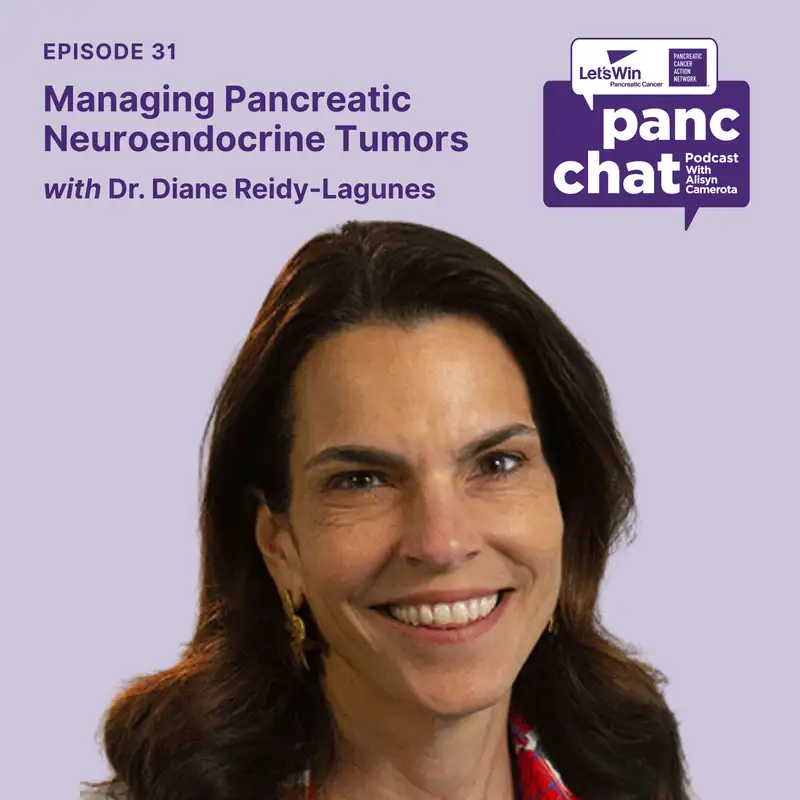
Managing Pancreatic Neuroendocrine Tumors
Cindy Gavin: Hi everyone, I'm Cindy Gavin, CEO and co-founder of Let's Win Pancreatic Cancer. On today's podcast, we are going to take a closer look at pancreatic neuroendocrine tumors, which are commonly known as PNETs, a topic near and dear to my heart.
Over to you, Alisyn and Dr. Reidy.
Alisyn Camerota: Hi everyone, welcome to PancChat. Today's episode focuses on PNET, which is a type of tumor that differs from the most common form of pancreas tumors, which is adenocarcinoma. PNET is different in terms of basic biology, treatment options, and survival rates. Before we get started, we want to thank our sponsor, Revolution Medicines. So let me introduce our guest today.
Dr. Diane Reidy-Lagunes is Chief of the Division of Medical Oncology and Vice President for Oncology Services for Duke University Health System. Her research focuses on developing methods to integrate molecular-based therapies into the treatment of neuroendocrine and adrenal tumors.
Welcome to PancChat, Doctor.
Dr. Diane Reidy-Lagunes: Thank you so much. I'm really excited and thrilled to be here.
Alisyn Camerota: Great to have you, Dr. Reidy. Okay, so today we're talking about pancreatic neuroendocrine tumors, or PNET, which, as I understand it, make up about ten percent of pancreatic cancer diagnoses.
Dr. Diane Reidy-Lagunes: That's correct.
Alisyn Camerota: So let's start there, okay? So what's the difference between PNET and the more common form of pancreatic cancer that we tend to know more about, which is the adenocarcinoma?
Dr. Diane Reidy-Lagunes: Yeah, so that's a really great question. So they're actually two completely different cancers. I tell my patients that the most common cancer that develops in the body is adenocarcinoma. So if someone says I have breast cancer, lung cancer, stomach cancer, ovary cancer, colon cancer, uterine cancer, it is traditionally adenocarcinoma. But there are other cancers that can develop in the body.
Neuroendocrine is another type of cell and another type of cancer. Melanoma, for example, would be yet another type of cancer. And so when we talk about neuroendocrine cancers, they are a different one called stem cell, we believe, and it kind of goes through a different pathway. We know cancer by definition is it starts because there's damage in the cell, and the damage occurs in the DNA, and we call that a mutation. When the DNA gets damaged, that's a mutation.
So neuroendocrine have totally different mutations, it's a total different cell. And like you said, biologically, it's completely different. The treatments are different, the outcomes are different, our patient population is different. So we're kind of talking about two different types of cancer, both of which start in the pancreas.
Alisyn Camerota: Okay, so what are the symptoms different for PNET than the adenocarcinoma?
Dr. Diane Reidy-Lagunes: They are, yeah. So, you know, typically, I share with my patients, adenocarcinoma, we've actually shown in the lab that when adenocarcinoma develops, it actually, almost at the time at which it develops, it figures out how to spread. Whereas a breast cancer, colon cancer, neuroendocrine cancer, sometimes it takes years, if at all, to figure out how to spread. It's not smart enough. Whereas adenocarcinoma, very early on, can figure out how to grow and then to spread.
And then often, unfortunately, because that happens so quickly, patients can start to get symptoms of pain or weight loss or diabetes. That's sort of the adenocarcinoma. For neuroendocrine, often it's found incidentally, that you're getting an imaging for some other reason and, lo and behold, there it is. And so that's one way we find it. Sometimes they are— in about 15 percent of the time, these tumors can do some funky things, one of which is produce a hormone that can actually cause devastating symptoms.
That's a small amount of patients. But it can cause diarrhea, it can cause lowering of the blood glucose when it makes a hormone called insulin. So insulin is actually being produced by the cancer, and then your glucose really drops, which can be life-threatening. It can make another one called gastrin, where it can make ulcers throughout the body. So there are different types of symptoms if you have the hormones.
And then sometimes patients do have disease that has spread, and they can start to feel some fullness in their abdominal cavity, or just not feel right, and that gets the imaging. And so there are some that can be symptomatic, but many of them are found incidentally.
Alisyn Camerota: Is the survival rate for PNET— or I should say, what is survival rate for PNET versus the traditional adenocarcinoma?
Dr. Diane Reidy-Lagunes: Yeah, and this is to your question before, that because it's slower growing, for our patients, even with advanced disease, many times they can live for many years. In a very exciting way, I would say we don't know the overall survival rate in 2026. And the reason is because we keep adding therapies on to our armamentarium that are allowing our patients to live a lot longer. And so we used to be that we thought maybe it's around eight years, six years, but honestly, that number just keeps changing because we have the advent now of peptide receptor radiotherapy, or PRRT, and other additional treatments like cabozantinib that we sort of added to the treatments that, for many of our patients, have kept that cancer for a lot longer. And we do a lot of liver-directed therapies for these types of tumors.
So the good news is, even in the very advanced setting, many of our patients can live for many years. Now, the way that we differentiate the different types of neuroendocrine is by a couple of things, but the most important is what we call the grade of the tumor. So unfortunately, there's three categories. There's low grade, intermediate grade, and high grade. And it's the high grade, unfortunately, that can portend a more difficult course.
And those patients may have an overall survival that is lessened. Again, still have great options and treatment for them, depending on the type and depending on how aggressive it is. But we can often differentiate the tumors based on the grade to allow our patients to understand, you know, the prognosis and what we are making our best guess on what we're looking at.
Alisyn Camerota: Let's talk a little bit more specifically about the treatment options for PNET. So what are those? Are those standard chemotherapy, surgery, what?
Dr. Diane Reidy-Lagunes: Great question. So I think if always, if it's in a localized— if we can surgically remove it to render what we call R0 resection, where we really believe we can take it all out and leave no cancer behind, surgery is the standard-of-care treatment. When we know that it's something that is sort of large enough or concerning enough that it needs to be removed. I say that because, again, because they are incidentally found, sometimes we'll see something that's just a couple millimeters, and we can watch it for a while because it might not ever grow. And so the test of time can often help us know who requires a surgery. Because unfortunately, as we know, in pancreas cancer, the pancreas is not a very forgiving organ.
And so if you cut it, it doesn't grow back like the liver. The liver will grow back tomorrow, but the pancreas won't. So we have to be very thoughtful, particularly in our patients that can live for many, many years, about the quality of life. So surgery is an option, but we have to know where it's located, is it going to be helpful for that patient, and then can we render them free of disease by doing that surgical approach. We also have, like I said before, liver-directed therapies.
So radioembolization, or bland embolization, or chemoembolizations, or ablations, all are different types of liver-directed approaches to try to treat the disease in the liver. Because close to 90 percent of the time, if our patients are going to get into trouble, it's from the liver disease. Even when they have cancer outside the liver, it's most times it's the disease in the liver that can cause the trouble. And then, like you said, we have several different types of chemotherapies and targeted therapies, as well as hormone therapies. So there's lots of different types of treatment options for neuroendocrine malignancies, as opposed to the adenocarcinoma, where we have more traditional chemotherapies plus daraxonrasib now.
Alisyn Camerota: Oh, well, I'm glad you brought that up because that's getting so— the daraxon—, how do I say it? Daraxonrasib, yeah. Daraxonrasib, which is the KRAS— Correct. —targeted therapy is getting so much attention. Does that work, or is this a different mutation?
Dr. Diane Reidy-Lagunes: It does not. That's exactly right. It's a different mutation, and it goes back again to a different disease. Neuroendocrine does not have KRAS alterations. Maybe that's why our disease is a little bit slower growing as compared to adenocarcinoma, because of that mutational profile, but that's not a drug that would be helpful for our patients.
Alisyn Camerota: So is it traditional chemotherapy that also helps?
Dr. Diane Reidy-Lagunes: Some chemotherapies will help, but actually what I call our first-string players, the best therapy we have is actually a shot in the bottom once a month. It's called either octreotide or lanreotide. And both of those drugs can be very good at stopping the cancer from growing and spreading. It doesn't shrink it; it doesn't make it go away. But for some patients, over years, they could be on this once-a-month injection and have the disease controlled.
So I always tell my patients, as long as it's not growing or not spreading, it really can't help— hurt us. We really want to make sure that the treatments that we're providing will treat the cancer, but with a solid side effect profile that's tolerable.
Alisyn Camerota: For sure. There are some examples of high-profile people who have had PNET, the PNET version of pancreatic cancer rather than the adenocarcinoma. Most famously, I suppose, was Steve Jobs, who was diagnosed in 2003 with PNET, I believe, and then died eight years later. So what did we learn from his case?
Dr. Diane Reidy-Lagunes: Yeah, I think that he is an example of someone that can live for years with this disease, and he did a lot during that time, as do many of our patients when they're living with this disease. There are, you know, I said the first-line therapies are also often that hormone shot. There are targeted treatments, a drug called cabozantinib, as well as everolimus and Sutent. There are traditional chemotherapies, something called 5-FU or platinum-based therapies, or Temodar. And then there is this sort of new— I wouldn't say new, but since 2018 in the United States, we have Lutathera, is FDA approved, and now other radiolabeled therapies that are coming down the pike, which is literally radiation that's tagged to octreotide, given by IV, and then can go anywhere that the cancer can go to sort of bind to the cancer and then internalize the radiation and zap it.
And I did not care for Steve Jobs, but from what folks have said, that was an option, for example, that he had received that kind of put the cancer at bay and controlled for a couple of years. Ultimately, he had a transplant that was public. That's also a potential option for our patients. What's a transplant? A liver transplant.
And that goes back again to what we were saying before. Most of our patients, when they get into trouble, it's the liver disease that grows. And so liver transplant is considered an option for our patients. The problem is it's rarely curative. Most of the data suggests that it can keep it at bay, and overall survival might be improved, but it doesn't eradicate the disease.
And that's because our cells can hide in the bone marrow, in the blood, and in other places, and then it could eventually get back to the liver. And now you're on immunosuppressive agents. So we have to be very careful on what we're choosing and when. In circumstances where the tumor, again, is making that hormone, like we discussed before, we tend to be a little bit more aggressive on things because the hormone itself can really impair the quality of life. And so we want to be able to treat that.
And again, there was a question as to if he had that hormone-producing symptoms, why he lost a lot of weight in between, and that kind of thing, and why they were maybe a little bit more aggressive in his treatment approach.
Alisyn Camerota: But that means— you raise a good point. Since the cancer can be so diabolical and so small and so microscopic and hide in so many places, how do doctors ever know when a transplant is the right course of action?
Dr. Diane Reidy-Lagunes: It's a really good question. And unfortunately, the best data for transplant seems to be in the ones that have the lowest grade and are the most indolent. And then you ask, then did you need it in the first place? Because the ones that are higher grade tend to be the ones that recur the most. And so that's not recommended for those that you're more worried about.
So it's this little bit of a balance of, you know, how aggressive do you and your patient want to be at a therapy that doesn't— it has its risks, infections and other things that we have when we're immunocompromised. Now, having a transplant is a big deal. And so I think you have to really kind of have those conversations. And it's also sort of from a public health perspective, like, how many transplants do we have to be able to even offer that? And depending on the state, it may not be as viable as an option because there's just a scarcity of liver transplants to have.
Alisyn Camerota: I see, that makes sense. Are there clinical trials happening right now about PNET that people could get into?
Dr. Diane Reidy-Lagunes: There are, absolutely. So this sort of radiolabeled, or the peptide receptor therapies, there are new types of radiation. There's something called actinium and lead that are now being tested in addition to the ones that are already FDA approved. So, new types of radiation with new receptors that folks are looking at. There are other targeted types of treatments that people are considering.
And for the ones that are higher grade, one of the concerning things about pancreatic neuroendocrine tumors is sometimes the tumor can sort of have this, what we call, grade transformation. So we're doing well for a while, and patients think, I'm feeling well; everything is going well. And then sometimes the cancer can start to pick up its pace. And when it does that, sometimes it could start to really pick up its pace. Now, that's usually in the advanced setting after multiple treatments, but the cancer can sort of transform into a more aggressive behavior.
And there is a receptor known as DLL3 that we— when I was at Memorial Sloan Kettering, my fellow, Dr. Thummalapalli, has found that expression is higher in these tumors as they transform. And so now there's other therapies that are exploring the use of treatments against that target as the cancer sort of changes its biology. So as cancer morphs over time, we're looking at different types of treatments. So we're very excited about that.
Alisyn Camerota: I mean, the research that you all do and the revolutions of research, as you're referring to, that it feels like every year something changes.
Dr. Diane Reidy-Lagunes: It really does, Alisyn. Like, I've not been as excited about research and about technology as we are today. You could feel it, and you can see it, you know, not only in neuroendocrine, but in pancreas and in other sort of solid tumors that I care for, but particularly in the neuroendocrine space, it just feels like we can understand the biology now in a way that we hadn't before, which allows us to explore new options. And so that hope is real.
I wish it would happen fast enough. You know, I think for our patients in clinic today, we want the treatment tomorrow. And we're not there yet, but we are making advances. And I think that's why many of us in the world of academic research are so excited about the opportunity for all these different therapies that we're hoping for in the future.
Alisyn Camerota: I mean, I've had a few of these conversations with many doctors like yourself, and they just describe this particular moment as, like, the Renaissance. This is the moment when, after all of these years of really bleak statistics, finally, like, this year, exciting things are happening.
Dr. Diane Reidy-Lagunes: And it's true. And I think I'd like to say we cracked the nut. We are not comfortable saying a doubling over a survival of 13 months, for example, with daraxonrasib is good enough. We're not stopping; we're just getting started. And that is what's so exciting.
We're finally able to target what we thought was untargetable. You know, we're drugging what we thought was undruggable- these mutations; that's what's so exciting. We're learning what it is about pancreatic neuroendocrine tumors when it picks up its pace to then hit it in a different way, where we used to be like, oh boy, it transformed, we're done, you know, that kind of thing. But we're not; we're just getting started again, and really understanding the biology of that type of tumor. Because, importantly, you know, cancer changes over time.
So the cancer we start with is very different than the cancer that causes a patient eventually to pass away. It's the cells that were more resistant to the treatments, they're more aggressive. So we've got to understand what that cell looks like to be able to target that.
Alisyn Camerota: What have I missed, Doctor? What else would you like to say about it?
Dr. Diane Reidy-Lagunes: I think that for our patients of today and tomorrow, they're the reasons I do what I do. I think that, importantly, there is a lot of hope for patients with neuroendocrine malignancies. I think going to an academic medical center, or at least a center that is a neuroendocrine excellence center, can be very, very beneficial, if only for a second opinion. I understand it's very hard sometimes for financial reasons for folks to travel, but you want to get somebody that understands the disease. There's a lot of nuances in this disease, and the sort of the art of medicine comes into play a lot more in this disease.
So it's important to have someone that understands it, and that can listen to you and understand what your wishes are, and how we might be able to sort of strategically define the treatments of what we're giving and when, because unlike other cancers, what we call the sequencing of treatments is not as clear in neuroendocrine. And that's a part because there's kind of what we call heterogeneous disease— some people are going to start off with aggressive disease that they need treatment right away. And some of them have very indolent disease that we don't need to do something right away. And so having a team of experts that understand the biology and that can help you and guide you and your loved ones through that is super important.
Alisyn Camerota: That's great advice. I mean, love the advice of getting a second opinion, even though it is often very difficult to relocate and go someplace for a clinical trial or to go someplace for treatment outside of your hometown.
Dr. Diane Reidy-Lagunes: But you can always bring back the helpful hints. And then once you're there, you're sort of part of there. Then you're sort of connected to potential for clinical trials in the future. You might even be able to do it in telehealth if it's within your own state. So there's ways to try to do it to minimize the financial toxicities.
Alisyn Camerota: That's great. Well, Dr. Reidy-Lagunes, thank you very much. It's been a pleasure to talk to you. I really— I appreciate it.
Dr. Diane Reidy-Lagunes: I love listening to you all, and I really appreciate being here today.
Alisyn Camerota: Thanks so much. And we also want to thank our sponsor, Revolution Medicines, as well as you, our listeners. Thanks so much for tuning in to PancChat. I'm your host, Alisyn Camerota, and I'll see you next time.
Julie Fleshman: Hi, I'm Julie Fleshman, President and CEO of PanCAN. If you or a loved one has been diagnosed with PNET or any type of pancreatic cancer, navigating this journey can feel overwhelming. But you don't have to do it alone.
You can explore the many resources we have on pancreatic cancer, including PNET, on our websites. You can find PanCAN at PanCAN.org and Let's Win at LetsWinPC.org. Together, PanCAN and Let's Win are committed to guiding you through every step of the pancreatic cancer journey, offering support, information, and hope.
In our next episode, we'll speak with Katie DeCarlo about her experiences with the diagnosis and treatment of PNET. Don't forget to follow PancChat to get new episodes delivered twice a month right in your podcast feed. PancChat is available on all major platforms, wherever you get your podcasts.